
Multi-Agent Artificial Intelligence in Modern Dentistry
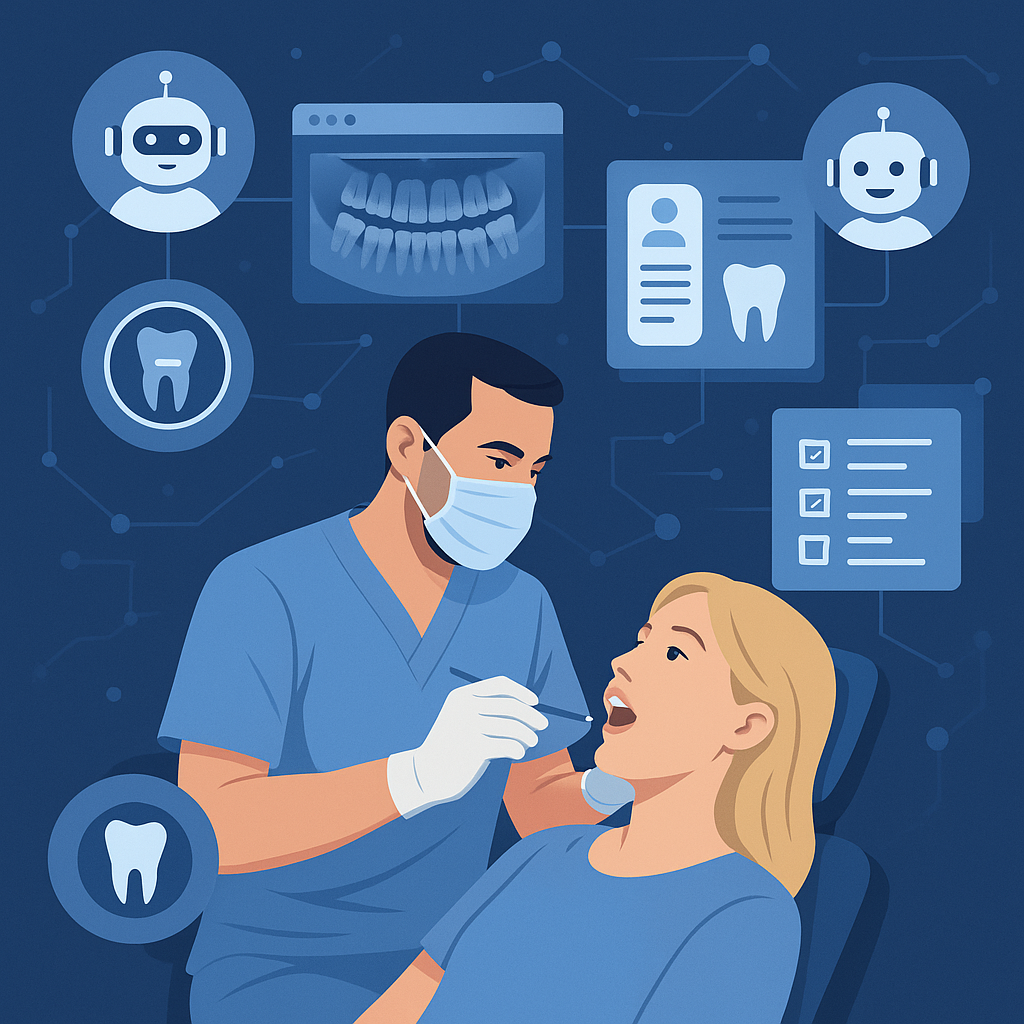
Dentistry is experiencing a silent revolution: the arrival of multi-agent Artificial Intelligence (AI) systems capable of organizing clinical information, supporting diagnosis, improving patient education, and optimizing treatment planning.
Unlike traditional chatbots, these systems employ multiple specialized agents that work in coordination to assist both the dentist and the patient throughout the entire care cycle.
Below, we present a practical and clinically-oriented overview of how these technologies will transform your daily practice.
1. The Current Problem: Information Overload and Poorly Informed Patients
Dental professionals face an increasingly complex environment:
- Scattered clinical records: radiographs, photos, STL models, PDF notes, and exams arriving from multiple sources.
- Limited consultation time: the average chart review time is 5–7 minutes per patient.
- Patient misinformation: many turn to “Dr. Google,” generating anxiety, myths, and resistance to treatments.
- Low adherence: up to 60% ignore hygiene or follow-up recommendations.
Multi-agent AI presents itself as a tool designed to alleviate these burdens without replacing clinical judgment, always keeping the professional as the final decision-maker.
2. What is a Multi-Agent System and Why is it Different from a Chatbot?
Instead of a single AI model that answers everything, this approach uses four specialized agents:
✔ 1. Information Organization Agent (in production)
- Automatically tags radiographs, photos, and documents.
- Classifies files into clinical categories (radiology, notes, consents, etc.).
- Enables clinical searches (“all crossbites since 2022”, “all bitewings from the last 2 years”).
Impact on your practice: Saves time, prevents errors, prepares each appointment with immediate context, and accelerates new patient intake.
✔ 2. Medical Research Agent (in development)
- Consults scientific sources and official guidelines (ADA, AAP, AAE, etc.).
- Responds with evidence and citations.
- Generates patient explanations in simple language.
Impact: Keeps you updated without extensive manual searches and allows you to provide solid, reliable educational materials.
✔ 3. Diagnostic Support Agent (experimental)
- Identifies patterns in radiographs.
- Compares images from different years to detect progression.
- Suggests differential diagnoses (always as proposals, not mandates).
Impact: Second pair of eyes for subtle findings, more precise temporal tracking, and less risk of missing something.
✔ 4. Treatment Planning Agent (experimental)
- Generates therapeutic alternatives with pros, cons, and estimated timelines.
- Builds staged treatment pathways.
- Manages administrative tasks and reminders.
Impact: Faster and more consistent plans, better-informed patients, and automated administrative workflows.
3. A New Model: Patient-Controlled Data
The system adopts an innovative approach: the patient owns their records, and the dentist receives specific permissions to view the necessary files.
This improves:
- privacy and trust,
- ease of changing professionals,
- clinical record integrity.
4. Intelligent “Patient Journey” Management
Beyond clinical AI, the system includes tools ready for real-world use:
In orthodontics:
- Automatic aligner reminders
- Monthly progress comparisons
- Lack of adherence alerts
In surgery:
- Postoperative instructions scheduled by day
- Early detection of complications through reported symptoms
In prevention and maintenance:
- Suggests prophylaxis intervals based on risk
- Educates the patient between visits
Direct result: Better adherence, fewer emergencies, less administrative work, and better-supported patients.
5. Deep Personalization: AI Learns from Each Dentist and Each Patient (Future Vision)
One of the most important innovations of the system is its ability to progressively personalize:
For the patient:
- Learns preferred schedules.
- Adjusts the level of technical detail.
- Modifies tone and communication style.
- Adapts recommendations based on previous behaviors.
For the dentist:
- Learns the professional’s diagnostic style.
- Integrates their favorite treatment protocols.
- Uses specialty-specific terminology.
- Adapts to the typical workflow of each clinic.
In practice: The AI “speaks” like you and assists you according to your way of working.
6. Proven Benefits for Dental Practice
⏱ Time Reduction
- 25% less time reviewing charts.
- Fewer administrative calls.
📈 Improved Clinical Outcomes
- Better detection of progressions (caries, periodontium, lesions).
- Greater postoperative and orthodontic adherence.
🤝 Better Informed Patients
- Personalized education.
- Reliable 24/7 answers.
- Drastic reduction in misinformation.
💸 Economic Benefit
- Increases appointment attendance through automatic reminders.
- Improves treatment acceptance thanks to evidence-based explanations.
7. Is it Ready for Clinical Use?
✔ Already safe to use:
- File organization
- AI assistant panel
- Patient journey management
- Personalized education
- Administrative automation
⚠ Still experimental:
- Diagnostic support
- Treatment plan generation
These modules require clinical studies and regulatory validation before direct use with patients.
8. Conclusion: The Dentist’s Role Doesn’t Disappear — It Gets Enhanced
Multi-agent AI does not intend to replace the professional. Its goal is to amplify capabilities, reduce administrative burden, and strengthen clinical communication.
In the coming years, we will see how these technologies:
- improve diagnostic accuracy,
- personalize care,
- boost patient compliance,
- and enable more efficient, wellness-centered consultations.
Early adoption will be a competitive advantage and an opportunity to offer smarter, more human, and more effective dentistry.