The mouth is a cheap, modifiable window into the chronic inflammation behind severe systemic conditions like heart disease and diabetes. Yet, for a clinical or translational researcher, testing these connections scientifically typically requires weeks of manual chart reviews, with the added risk of finding that crucial clinical data was either never collected or remains locked inside disconnected systems.
To bridge this gap, our CTO and co-founder, Matías Molinas, designed an innovative project for Anthropic's global hackathon "Built with Claude: Life Sciences". The tool is a non-diagnostic, agentic clinical-research navigator capable of taking a scientist from a biological hypothesis to a research-ready cohort in minutes, operating autonomously under supervised human direction.
Below, we break down the technical details of this milestone and share the video demonstration of the project.
Watch the Video Demonstration
To see the project running live and verifying genetic linkages, you can access the video directly on YouTube using the link below:
👉 Watch the demonstration on YouTube: https://www.youtube.com/watch?v=qNmgm4Bs4Dw
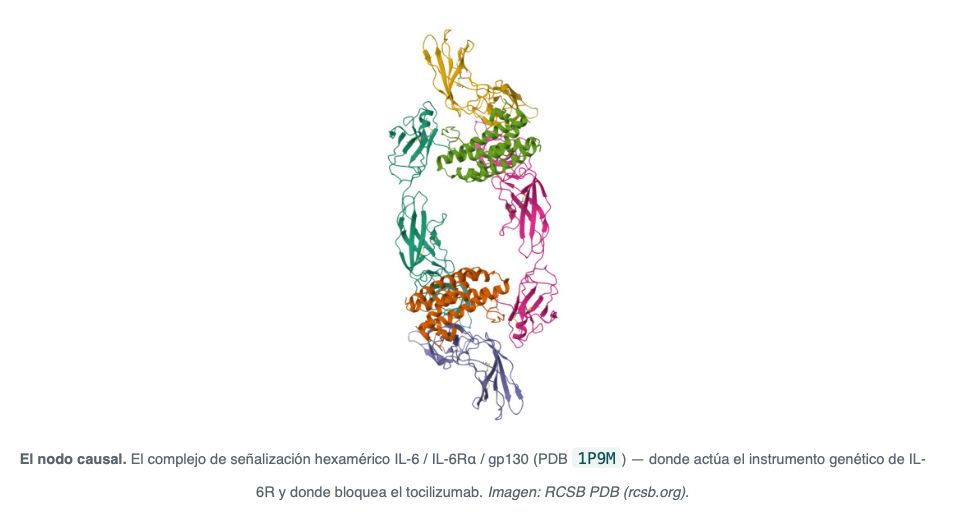
The causal node. The hexameric signaling complex IL-6 / IL-6Rα / gp130 (PDB 1P9M) — where the genetic instrument of IL-6R acts and where tocilizumab blocks. Image: RCSB PDB (rcsb.org).
How Does 'Claude Science' Work? A Supervised Autonomous Loop
The tool was developed under Matías's direction using Claude Code (Anthropic's next-generation terminal tool). Under his guidance, Claude Code wrote the entire data-processing engine, designed the automated testing suites, and programmed the non-diagnostic guardrails that guarantee the system remains strictly an aid for clinical research, never cross-stepping into diagnostic territory.
Once compiled, the system operates as a background clinical-research assistant. Driven by a dedicated Chrome extension, Claude Code powers a specialized Claude Science agent that executes live queries and verifies biological assertions, auditing its progress dynamically.
1. Massive Filtering in Seconds: From 20,905 Participants to 442
By connecting to the massive, publicly available NHANES (National Health and Nutrition Examination Survey) dataset, the agentic navigator builds a highly rigorous eligibility funnel in seconds:
- Original Population: 20,905 participants.
- Dynamically Applied Clinical Filters: Oral health habits, systemic inflammation markers, age ranges, and lifestyle parameters.
- Resulting Study Cohort: 442 highly specific participants, fully prepared for genetic linkage analysis.
2. Absolute Data Honesty: No Imputations or Hallucinations
A frequent danger when utilizing generic large language models in healthcare is data hallucination or improper data imputation. HISTORA’s research architecture forbids this by design:
- Missing Value Flags: If a data point is missing from the underlying dataset, the system never attempts to impute or "invent" it. Instead, it flags the missing value as a physical collection error in the record.
- Population-Level Ranges: To maintain strict patient privacy, the tool outputs ranges and aggregated findings at the population level, never exposing or reasoning about an individual patient’s absolute values.
Live Genetics Validation: Disentangling Correlation from Causality
The true power of pairing HISTORA’s structured clinical data infrastructure with an agentic scientific engine is demonstrated when the system evaluates complex, falsifiable biological hypotheses in real time:
- The Coronary Disease Pathway (Causal Link): The AI agent analyzed the genetic causal relationship of specific inflammatory biomarkers. It successfully confirmed that the IL-6R (interleukin-6 receptor) variant is genetically causal for coronary disease — a finding that the system autonomously replicated by cross-analyzing data across European and East Asian cohorts.
- The Circulating C-Reactive Protein Marker (Association, Not Causal): The system verified that circulating C-Reactive Protein (CRP) — although a widely used clinical biomarker for inflammation — does not have a direct genetic causal link to coronary disease.
- The Alzheimer’s Axis (Exploratory / Null): In keeping with rigorous scientific honesty, the agent determined that the genetic signals for the Alzheimer’s pathway within the current dataset are null, transparently classifying this line of study as purely exploratory.
Self-Auditing & Resiliency: "A tool that can only ever agree with itself is worthless"
The most revolutionary aspect of this project is the integration of an independent Reviewer Agent that constantly monitors the analyzer's output. If the analysis agent makes an analytical error, the reviewer flags it, requests an immediate adjustment, and verifies that the new mathematical model is scientifically coherent.
During the recording of the live demo, the system proved this capability by catching a math bug in its own flagship calculation:
- It caught a discrepancy and retracted an initial value of +0.705.
- It corrected the mathematical calculations in real time to establish the correct value of +0.553.
- It automatically wrote and shipped a regression test to ensure that specific analytical error never occurs in the code again.
As Matías emphasizes in the video: "A tool that can only ever agree with itself is worthless." Real science demands falsifiability, self-criticism, and absolute mathematical rigor.
A Key Foundation for HISTORA's Data Infrastructure
While this project focuses on large-scale life sciences databases, the agentic technology, interoperability frameworks, and regulatory guardrails designed by Matías directly feed into the core product of HISTORA.
By acting as the trusted clinical data infrastructure for dentistry, we are building the secure, structured, and interoperable layer upon which intelligent clinical agents will operate in the future. Our long-term mission is to connect dental records with broader systemic health data, enabling the lifelong dental digital twin for every patient — helping professionals and patients see the human body as an interconnected system.
The entire project has been open-sourced under the Apache License, allowing biomedical and clinical research teams globally to clone, audit, and run the pipeline 100% independently.