A patient's medical history is often a chaotic stack of files: CBCT scans, STL models, photographs, PDFs, and laboratory reports uploaded over many years, from different clinics, in no particular order. Today, someone has to make sense of that pile every single time — usually the dentist, in the few minutes before a consultation.
HISTORA® is built to change this. Our technology does that work continuously, in the background, shaped around the specific professional looking at it. The same record should look different to a periodontist tracking bone loss than to the orthodontist who placed the appliance.
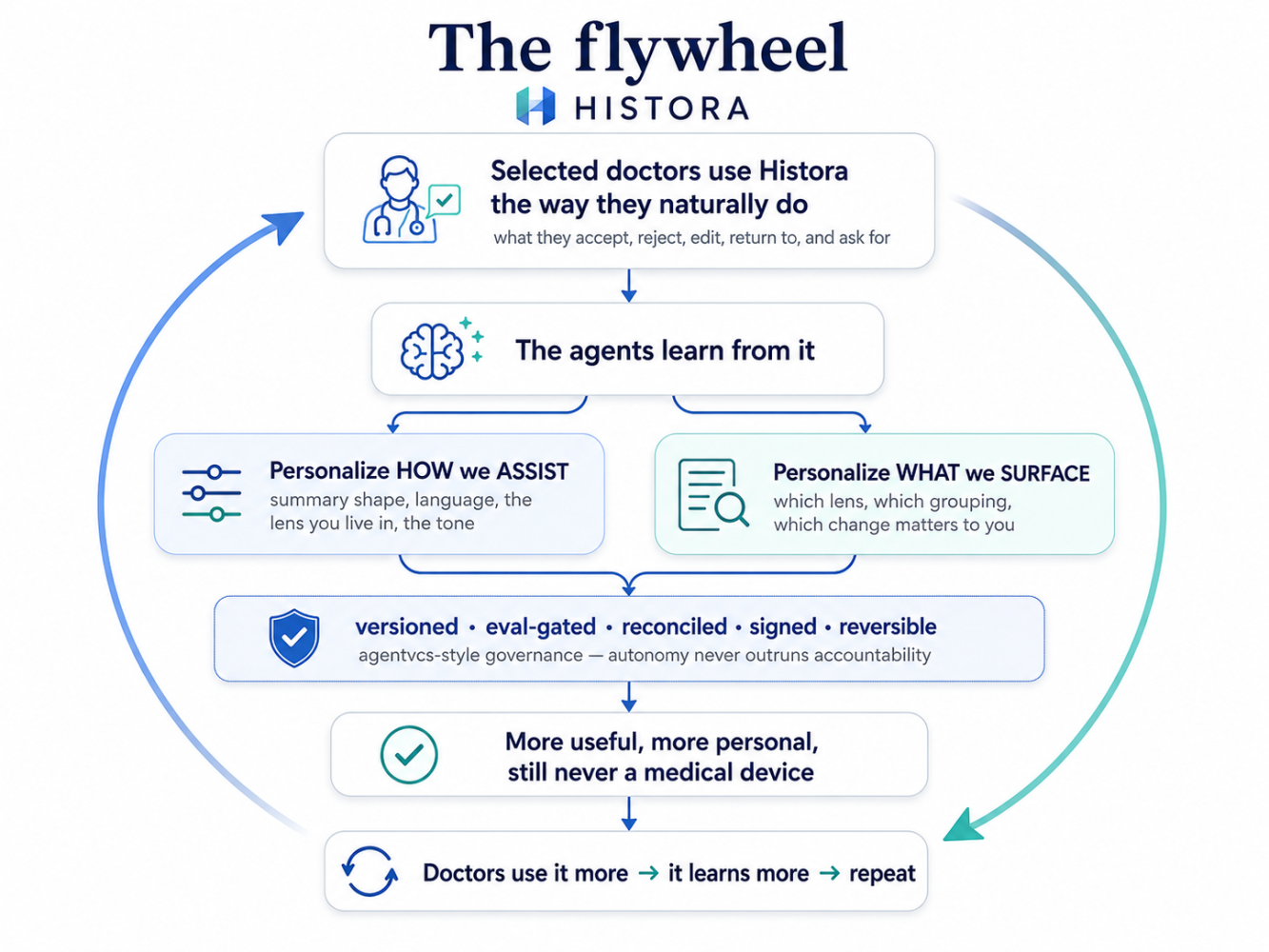
Until now, our digital assistants have been reactive. They answer when asked and propose when triggered. With our new beta, we are crossing a new frontier: for a selected group of dental professionals, our assistants become proactive and personalized — autonomous agents that learn how each dentist uses HISTORA and quietly keep the record organized, summarized, and surfaced exactly the way they need, without being asked every time.
But how do we ship this clinical autonomy safely?
Part 1: Proactive Autonomy in the Beta
In the upcoming cohort, we are addressing five reactive, high-friction problems with proactive agentic solutions:
- Continuous Summarization: Instead of clicking "generate summary" every time a new file is uploaded, the HISTORA agent continuously regenerates only what has changed. When the doctor opens the patient profile, the multi-layered summary is already up to date.
- Learning the Doctor's Voice: The agent learns the doctor's preferences from how they consistently edit. A surgeon who prefers a terse, structured problem list over a verbose narrative stops being offered long text. The agent learns how the doctor likes to read, never what is clinically true.
- Adaptive Specialized Lenses: The agent learns which specialized lens (periodontal, endodontic, orthodontic, general) each dentist prefers. The system defaults to the lens they accept and phases out the ones they reject.
- Proactive Change Flagging: Instead of waiting to be queried about progression, the agent pre-warms the relevant clinical lenses and highlights significant changes (e.g., comparing a new periapical film with historical files on tooth #14).
- Dynamic Referral Packages: When sharing a patient with a colleague, the referral package is prepared immediately, filtered strictly by patient consent, and structured in the specific format preferred by the receiving specialist.
Part 2: What Autonomy Means (And What It Never Means)
In a clinical setting, autonomy must have strict boundaries.
At HISTORA, autonomous means the agent organizes files, learns presentation preferences, surfaces relevant changes proactively, and improves continuously through human feedback.
Conversely, autonomous never means the agent diagnoses, decides, or treats. The agent personalizes how it assists, never what is clinically true. Furthermore, it never changes records on its own (every edit is proposed and requires human confirmation), never speaks without a citation, and never drops its guardrails. The agent learns the person, not the medicine.
Part 3: Running Autonomous Fleets Safely in Production
The moment an agent adapts to a doctor in production, we face a major challenge: design-time development (what our engineering team builds and ships) and run-time evolution (what each agent learns in the field) start running in parallel.
If we run a normal platform deployment, we risk clobbering everything the agent has learned, or letting the agents drift from our audited baseline. To solve this, we are evaluating multidimensional versioning strategies modeled on open-source experiments like agentvcs ("git for agents"):
- Multidimensional Commits: Every adaptation is captured as a commit containing skills, model, topology, and the trace that caused the change, making any behavioral shift inspectable.
- Reconciled Merges: When shipping a platform release, we use an intelligent, human-in-the-loop merge (
merge --reconcile) to combine the new platform capabilities with the learned personalization. - Eval-Gated Promotion: Learned adaptations run in shadow mode and are only promoted to the doctor once they clear strict agreement thresholds.
- Signed Provenance: Every statement is cryptographically signed, mapping outputs directly to the specific agent version, model, and prompt that generated them.
- One-Command Rollback: If an agent learns a suboptimal pattern, we can instantly roll back its state across all dimensions.
The Bottom Line
Autonomy in digital health is not just about making systems smarter; it is about making them more auditable, transparent, and secure. By combining personalized agentic features with rigorous versioning and validation pipelines, HISTORA ensures that as our technology evolves in the field, we keep the receipts.
This article is based on the technical insights shared by Matías Molinas, CTO of HISTORA, regarding our ongoing research into agentic safety and production deployment of autonomous AI clinical agents.